MSc thesis project proposal
Development of Unique Feature Maps for in-ECU PCBs Using Sensor Data
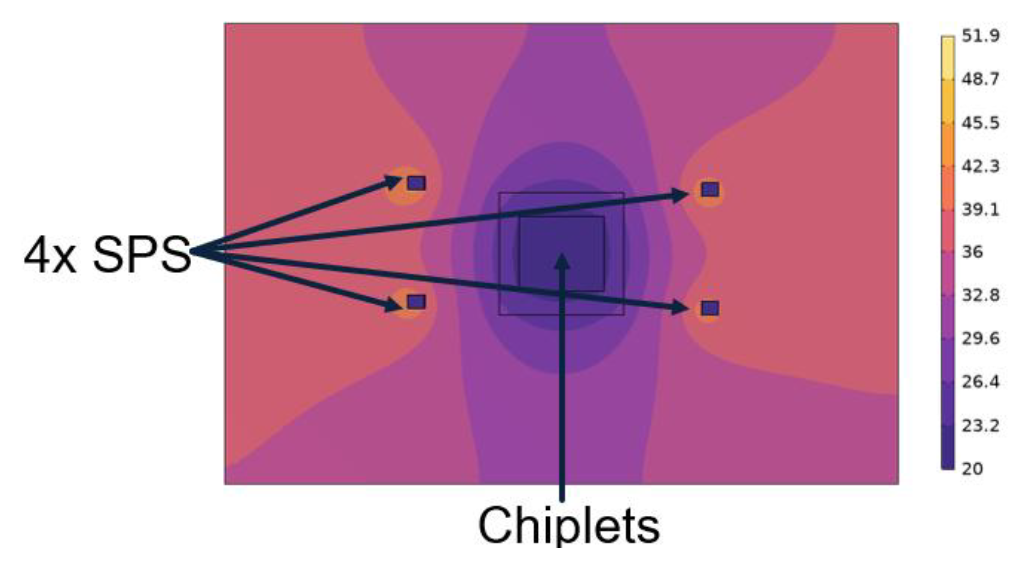
This thesis investigates a sensor-based, physics-derived hardware fingerprint for ECU authentication. Existing power devices are used as controllable excitation sources, while existing temperature sensors provide the response. The measured thermal response is reduced to a small set of robust features and compared with a stored reference fingerprint using a lightweight threshold-based algorithm suitable for implementation on a basic microcontroller. The work includes reading out temperature sensors and translating thermal impedance curves from analogue into digital domain with an unique and reproducible description, evaluation of the resolution and limitations of the methodology, development of demonstration hardware with custom PCB layers for distinguishable thermal profiles. Translate combinations of sensor values into a reduced order 2D thermal model and benchmark against FEM models. The generated temperature map could be extended with additional features such as stress from another set of sensors or stress sensitive devices. Possibly evaluation of stress sensitivity of GaN HEMT devices and stress map of PCB with multiple GaN HEMT devices under different stress conditions. The project combines thermal modelling, validation and hardware development/prototyping. The outcome will be a sensor-based feature map with a set of discrete parameters to uniquely identify a PCB, recognize malicious handling and analyse the approach for resolution and limitations.
The computing power in vehicles has steadily increased over time. Among more entertainment features, more safety relevant applications and functionalities are implemented in e.g. modern self-driving cars. Safety relevant applications require advanced security not only on software level but also on hardware level to prevent unauthorized access or system manipulation. This thesis investigates how already placed sensors for system monitoring can be further utilized for security.
Electronic control units (ECU) for self-driving cars inhibit complex and safety relevant functionalities and should therefore not be maintained by untrained personnel. Furthermore, they pose a safety risk when manipulated by people with nefarious intentions. Smart hardware implemented fingerprints can help to recognize such manipulations. However, the thermal response of a PCB with many components depends on several factors such as TIM thickness, screw torque etc. Variations between different boards might be too small to detect for an unique fingerprint. Specifically designed layers might enable an unique detection for each board. The project will therefore investigate the feasibility, reproducibility and limitations with concrete design guidelines for safety relevant systems suitable for thermal based security features.
Assignment
Evaluate thermal sensor readouts at different location on a PCB to create an unique temperature map and show its robustness and limitations. The project starts with a literature review and simulations to define a set of suitable PCB designs. A set of different PCBs is designed, manufactured and assembled. Different designs can be proposed for temperature or stress focused investigation. The assembled PCBs are tested and compared to simulated designs. The sensor data is converted into the digital domain (software based or hardware based on the board directly) and a fingerprint is extracted based on the minimal number of parameters. The work is primarily experimental, with modelling used to make design choices and represent measurement results.
Contact
MSc Ole Bergmann
Electronic Components, Technology and Materials Group
Department of Microelectronics
Last modified: 2026-09-01