MSc thesis project proposal
Flapping-Wing Drone Swarm for Greenhouse Monitoring
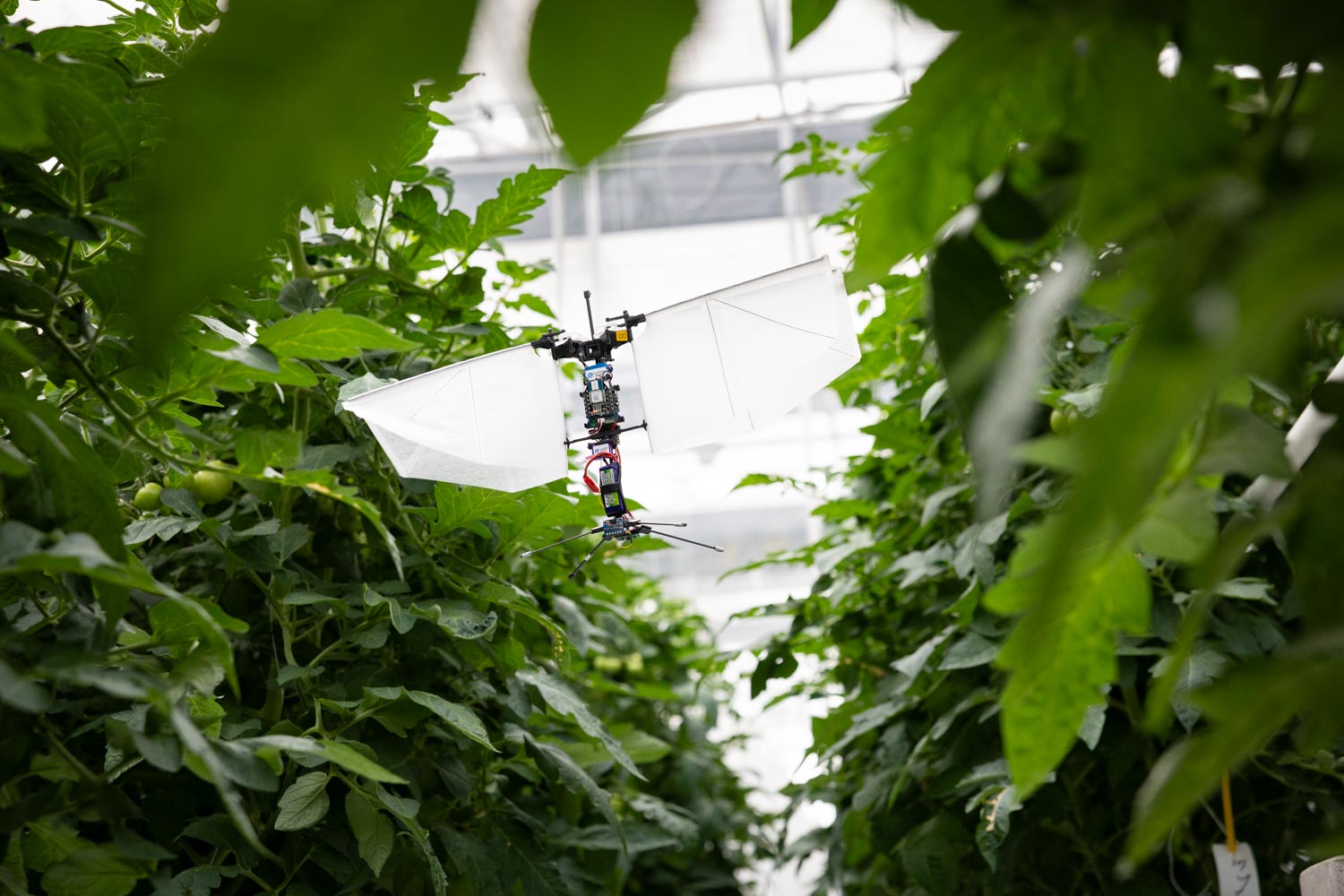
As the global population continues to grow, the demand for food is steadily increasing. Meeting this demand in a sustainable manner requires more efficient agricultural practices with a reduced environmental impact. This challenge is particularly relevant in greenhouse horticulture, where large-scale production must be balanced with responsible resource use. The Biomimicry Research Group at Inholland University of Applied Sciences, in partnership with TU Delft, is addressing this issue through the Flappy Project (see: https://www.inholland.nl/onderzoek/onderzoeksprojecten/flappy-project/). The project aims to reduce pesticide usage by developing a drone-based monitoring system (DBMS) capable of performing frequent and automated crop inspections. Early detection of pests and diseases allows growers to intervene in a more sustainable way, for example by introducing natural predators or applying minimal amounts of (bio-)pesticides. Currently, crop monitoring is largely performed manually, which is becoming increasingly labor-intensive as greenhouse operations expand. Automating this process will help growers cope with the ongoing labor shortage in the sector, while simultaneously improving sustainability and providing clear economic benefits.
Assignment
As part of this larger effort to build a fully autonomous greenhouse monitoring swarm, this assignment focuses on the navigation and exploration subsystem. You will develop and test the algorithms that let a drone autonomously explore a greenhouse row structure, decide where to search next, and determine when and how to return to a moving charging platform for recharging. This includes validating your approach through simulation and hands-on testing to ensure it performs reliably under realistic conditions.
Scope and Expected Activities
· Conduct a literature review of exploration and search algorithms suited to constrained, row-based environments, as well as approaches for relative navigation and rendezvous with a moving platform
· Define functional requirements for autonomous exploration and return-to-base behavior
· Develop a search/exploration strategy for navigating greenhouse rows (e.g., coverage planning, frontier-based exploration, or similar approaches)
· Design the return-to-platform logic, including decision criteria for when to return (e.g., battery-level thresholds, task completion, mission time) and how to approach a moving platform
· Specify the sensor and data requirements needed to support these navigation decisions (e.g., relative localization, obstacle detection, row/crop detection), accounting for the weight and payload limitations of the flapping-wing platform
· Build a proxy setup to test return-to-moving-platform behavior
· Develop and test the navigation and decision-making algorithms in simulation and lab conditions, iterating based on results
· Document the process, results, and conclusions in a final report
Requirements
We are looking for a motivated and proactive student or a student team with an interest in robotics and sustainable agriculture. The ideal candidate enjoys working on practical engineering challenges and collaborating within a multidisciplinary environment.
Relevant skills and interests include:
· Programming experience (e.g., Python, MATLAB, or similar)
· A hands-on mindset and willingness to experiment and iterate
· Basic knowledge of signal processing and data transmission
· Affinity with robotics, autonomous systems, or system integration
· Ability to work effectively in a multidisciplinary team
This work will be in collaboration with InHolland and MAVLAB
Contact
dr. Raj Thilak Rajan
Signal Processing Systems Group
Department of Microelectronics
Last modified: 2026-07-07