MSc thesis project proposal
Spatial Wideband Effects in mmWave Multi-User Communication Systems
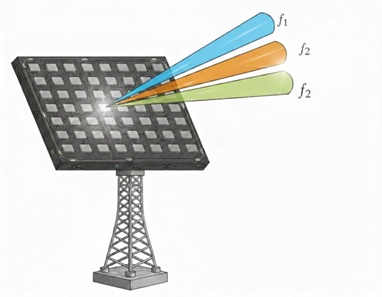
In mmWave communication systems used in 5G and beyond, large antenna arrays transmit signals over very wide bandwidths, and at these high frequencies, even small differences in propagation delay across antenna elements become significant. Consequently, signals no longer arrive at all antennas simultaneously, which violates the traditional narrowband assumption underlying many array processing techniques. This leads to what is known as the spatial wideband effect, which in turn causes distortions in beamforming. In particular, it results in beam squint, where the beam direction varies across frequencies, and beam split, where the signal spreads rather than remaining focused. As a result, beam alignment between the base station and user equipment becomes less accurate, ultimately degrading communication performance and throughput.
At the same time, although these effects introduce challenges, the spatial wideband phenomenon also creates additional signal diversity that can be exploited to improve system design, for example, by reducing pilot training overhead in channel estimation. To address the adverse impacts while leveraging potential benefits, existing approaches in the literature include hybrid precoder/combiner design to mitigate beam distortion, as well as the use of intelligent reflecting surfaces to reshape or assist the propagation environment. Therefore, developing advanced approaches to control or exploit spatial wideband effects remains essential for improving performance in multi-user mmWave communication systems.
Assignment
The goal of this project is to develop new techniques to mitigate spatial wideband effects and improve performance in multi-user scenarios, with the objective of enhancing overall throughput and system reliability. The project with be jointly supervised by Rupam Chakraborty and Geethu Joseph.
Requirements
For this project, we are looking for a master's student in either electrical engineering or a related field. Furthermore, we are looking for a student who has a background in signal processing, basic statistical techniques, data analysis, and programming skills in Matlab, Python, and/or C/C++. Strong communication (written and verbal) skills in English are mandatory.
Contact
dr. Geethu Joseph
Signal Processing Systems Group
Department of Microelectronics
Last modified: 2026-04-07