MSc thesis project proposal
The “THz Catastrophe”
Background: Challenging and Expanding our Understanding of Thermal Radiation
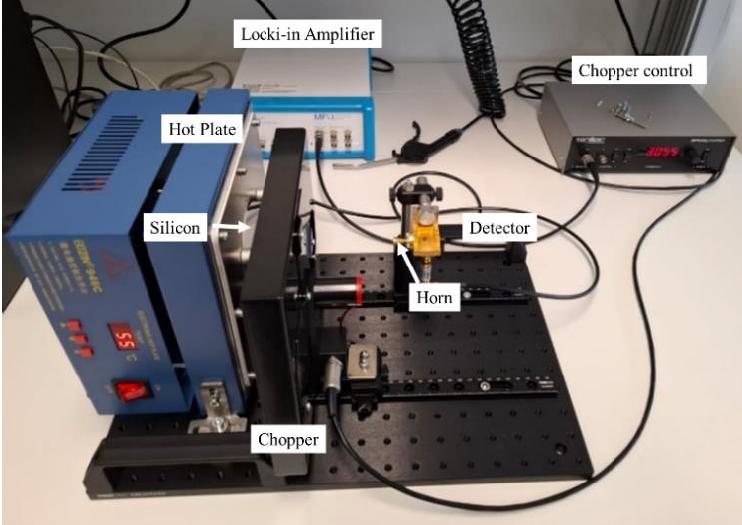
Recent measurements at TU Delft revealed unexpected thermal radiation from silicon wafers. The radiation shows a doping-dependent frequency decay (“THz Catastrophe”) that cannot be explained using Kirchhoff’s law or Planck’s radiation law.
A new classical model for thermal radiation has been proposed to explain the unexpected observations. It uses a modal expansion of the electromagnetic Degrees of Freedom (DoF). For simplicity, the initial expansion was derived for an infinitely large radiating body, with the finite geometry accounted for only afterward.
Theoretical work
In the first thesis work it is proposed to:
1)The goal is to refine the new model by incorporating the specific geometry of the radiating structures. The candidate will use the group’s 3D Method of Moments tool to compute eigenvalues and eigenvectors for the chosen geometry and identify modal functions that describe the thermally excited fields while accounting for finite-size effects.
2)Generalize the model to identify electromagnetic and thermal modes for various dispersive materials and loss mechanisms beyond simple Ohmic behavior. This includes accounting for radiative transfer as thermal radiation propagates, attenuates, and generates additional emission within the dispersive medium.
Experimental work
The second candidate will support a renewed experimental characterization of the thermal radiation properties of the studied geometries. Current measurements use ultra-sensitive, room-temperature zero-bias detectors capable of detecting ~pW of radiative power with minutes-long integration times. To improve and broaden our thermal spectroscopy capabilities, reducing detector temperature, and thus noise, is key. The candidate will explore detector-cooling strategies, from moderate cooling to cryogenic conditions, study how detector performance varies with temperature, and assess the reproducibility of this approach through dedicated measurement campaigns.
Contact
prof.dr. Andrea Neto
Terahertz Sensing Group
Department of Microelectronics
Last modified: 2025-12-04